Showing posts with label communication process. Show all posts

Understanding Noise in the Communication Process


Communication is often viewed as a straightforward exchange of information. However, communication theorists have long emphasized that the process is far more complex. Even when a message is clearly constructed, it may not be accurately received or interpreted.

One of the most significant factors contributing to this breakdown is noise—a central concept in communication theory.


Theoretical Foundation: The Shannon-Weaver Model

The concept of noise is most prominently illustrated in the Shannon-Weaver Model, one of the earliest and most influential models of communication. This model outlines communication as a linear process involving:

  • Sender
  • Encoder
  • Channel
  • Decoder
  • Receiver

Within this framework, noise is any interference that disrupts the signal as it travels through the channel.

Originally developed to improve telecommunications, the model remains highly relevant in analyzing human communication, particularly in environments where messages are frequently distorted or interrupted.


Revisiting the Four Types of Noise

While the Shannon-Weaver model introduces noise broadly, contemporary communication studies categorize it into four distinct types:

1. Physical Noise

External, environmental interference that disrupts message transmission.

2. Psychological Noise

Internal mental or emotional states that affect interpretation.

3. Physiological Noise

Biological conditions that limit the ability to process information.

4. Semantic Noise

Confusion arising from language, symbols, or meaning.


Case Studies: Noise in Everyday Communication

To fully understand the impact of noise, it is useful to examine how it operates in real-world contexts.

Case Study 1: Digital Miscommunication (Semantic + Psychological Noise)

Scenario:

A student sends a brief message: “Okay.”

Outcome:

The receiver interprets the message as dismissive or irritated.

Analysis:

Semantic noise: Lack of tone and context in text-based communication

Psychological noise: The receiver’s assumptions or emotional state shape interpretation

Insight:

Digital communication amplifies semantic noise because nonverbal cues are absent.


Case Study 2: Multitasking in Academic Settings (Physical + Psychological Noise)

Scenario:

A student attempts to follow a lecture while checking notifications on their phone.

Outcome:

Key information is missed or misunderstood.

Analysis:

Physical noise: Device interruptions

Psychological noise: Divided attention reduces comprehension

Insight:

Even minimal distractions can significantly impair message retention.


Case Study 3: Fatigue and Communication Breakdown (Physiological Noise)

Scenario:

An individual studies late into the night and struggles to understand reading material.

Outcome:

Misinterpretation and reduced comprehension.

Analysis:

Physiological noise: Fatigue limits cognitive processing

Insight:

Effective communication depends not only on clarity, but also on the receiver’s physical readiness.


Case Study 4: Ambiguous Language in Group Work (Semantic Noise)

Scenario:

A team member instructs others to “finish the project soon.”

Outcome:

Group members interpret “soon” differently, leading to missed deadlines.

Analysis:

Semantic noise: Vague language leads to inconsistent understanding

Insight:

Precision in language is critical for shared meaning.


Why Noise Is Increasing in Contemporary Communication


Several factors contribute to the growing impact of noise among teens and young adults:

A. Increased reliance on digital communication

B. Constant exposure to notifications and media

C. Cultural and linguistic diversity

D. Higher levels of multitasking

These conditions create an environment where multiple forms of noise often occur simultaneously, increasing the likelihood of miscommunication.


Strategies for Reducing Noise: An Applied Approach

Drawing from both theory and practice, the following strategies can improve communication effectiveness:


1. Control the Communication Environment: Reduce external distractions when conveying important information.


2. Develop Self-Awareness: Recognize how internal states (stress, assumptions) influence interpretation.


3. Prioritize Clarity and Precision: Use specific, unambiguous language.


4. Adapt the Channel: Select appropriate communication methods (e.g., verbal vs. written) based on message complexity.


5. Encourage Feedback: Confirm understanding to ensure the message was received as intended.


Conclusion

Noise is an unavoidable component of the communication process, yet it is often underestimated. Through the lens of the Shannon-Weaver Model, it becomes clear that communication breakdowns are not simply the result of poor messaging, but of interference at various stages of transmission and interpretation.

By identifying and addressing different types of noise, individuals can significantly improve both the clarity and effectiveness of their 

Facilitators & Barriers of Communication

Selecting appropriate mediums, channels and technologies
This takes place at the level of conceptualization.
When a sender decides to encode a message, he or she must take two main things into consideration during this stage – the context and the audience (receiver). These factors influence both choice of medium and choice of channel. The key word here is appropriateness. Choice of medium and channel are directly influenced by the purpose of the message and the intended audience. Ask yourself the following questions when determining levels of appropriateness:

i. Who is my receiver?
ii. How best can my message be conveyed?
iii. Where is the communication act taking place?
iv. What is the situation surrounding the communication act?
v. Is my audience one person or several?
vi. What medium should I use, oral or written?
vii. Should I use technology? If so, which technology would most appropriate?

 Scenario 1
Read the scenario below and answer the questions that follow.
Greg is ill and has to be away from school for two weeks. His mother encodes a letter to the school principal and sends it out in the mail.

In the above situation,
1. How else could Greg’s mother have gotten the message to the Principal?
2. Why do you think she chose to write a letter?

Answer: The telephone or email could have been used. She chose the letter because a letter is a more formal medium of communication and can serve as a permanent record.

Facilitators &; Barriers to Communication
Noise is anything that interrupts or blocks the flow of information. Whenever the understanding of a message is affected, the obstruction is considered a barrier to communication.
Some common barriers to communication are:
i. A language barrier
ii. A channel that is inaccessible to the receiver
iii. The message is ineffectively encoded or the meaning is ambiguous
iv. The medium is inappropriate to the message

Some common facilitators to communication are:
i. Choosing a familiar language
ii. Using an accessible channel
iii. Ensuring that the medium is appropriate to the message
iv. Using audio/visual aids to enhance the encoding of the message

The Communication Process & The Elements of Communication


Systematic=Step by Step=Process

Communication as a Process
Human communication is interpersonal, it is purposive and it is a process.
Question: What do we mean by process?
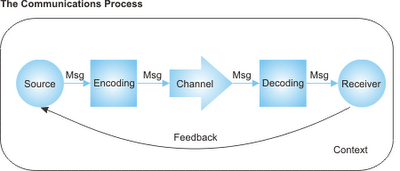
Answer: By process we mean that steps have to be taken and in a set/particular order to achieve a desired result/goal. These are the important elements of the communication process:

1. SENDER/ENCODER
The sender also known as the encoder decides on the message to be sent, the best/most effective way that it can be sent. All of this is done bearing the receiver in mind. In a word, it is his/her job to conceptualize.
The sender may want to ask him/herself questions like: What words will I use? Do I need signs or pictures?

2. MEDIUM
The medium is the immediate form which a message takes. For example, a message may be communicated in the form of a letter, in the form of an email or face to face in the form of a speech.

3. CHANNEL
The channel is that which is responsible for the delivery of the chosen message form. For example post office, internet, radio.

4. RECEIVER
The receiver or the decoder is responsible for extracting/decoding meaning from the message. The receiver is also responsible for providing feedback to the sender. In a word, it is his/her job to INTERPRET.

5. FEEDBACK
This is important as it determines whether or not the decoder grasped the intended meaning and whether communication was successful.

6. CONTEXT
Communication does not take place in a vacuum. The context of any communication act is the environment surrounding it. This includes, among other things, place, time, event, and attitudes of sender and receiver.

7. NOISE (also called interference)
This is any factor that inhibits the conveyance of a message. That is, anything that gets in the way of the message being accurately received, interpreted and responded to. Noise may be internal or external. A student worrying about an incomplete assignment may not be attentive in class (internal noise) or the sounds of heavy rain on a galvanized roof may inhibit the reading of a storybook to second graders (external noise).
The communication process is dynamic, continuous, irreversible, and contextual. It is not possible to participate in any element of the process without acknowledging the existence and functioning of the other elements.

Featured post

The Communication Process & The Elements of Communication

Systematic=Step by Step=Process Communication as a Process Human communication is interpersonal, it is purposive and it is a process....