Summary Writing Guide for Communication Studies Exam

Summary writing or concise writing is a skill often tested for in many subjects, especially Communication Studies. In this blog you will learn:

  • What is the purpose of a summary
  • What makes a good summary
  • Summary writing tips and tricks


Understanding the Purpose of a Summary

A summary condenses the original text, presenting the main ideas in a concise form. For the Communication Studies exam, this skill is critical for demonstrating comprehension and the ability to distill key information effectively.

Key Components of a Good Summary

Brevity: Summaries should be short, typically 1/3 of the original text.

Clarity: Avoid vague language and clearly present the main points.

Objectivity: Only include information from the source without inserting personal opinions or interpretations.

Accuracy: Ensure that the original meaning of the text is retained.


Steps to Writing an Effective Summary

Step 1: Read and Understand the Text

  • Read the passage carefully at least twice.
  • Identify the main ideas and supporting details.
  • Pay attention to the topic sentences of paragraphs, as they often summarize the key point.

Step 2: Identify Key Information

  • Eliminate any unnecessary information like examples, anecdotes, or opinions.
  • Focus on the "who, what, where, when, why, and how" of the text.

Step 3: Create a Draft

  • Use your own words to rewrite the key ideas.
  • Ensure you are preserving the meaning but shortening the content.
  • Avoid using direct quotes unless necessary.

Step 4: Revise for Conciseness

  • Make sure your summary is brief while covering all essential points.
  • Revise for grammatical correctness, coherence, and fluidity.

Step 5: Edit for Accuracy

  • Compare your summary to the original text. Ensure all the important ideas are included and no significant points are omitted.


Common Pitfalls in Summary Writing

Too much detail: Including minor points or examples that should be left out.

Paraphrasing too closely: Rewriting the text too closely to the original wording.

Missing the main idea: Focusing on secondary points rather than the primary argument.

Adding personal opinions: The summary should reflect the author’s ideas, not your views.


Practice Tips

Timed Practice: Practice summarizing under exam conditions, where time is limited. Set a timer for 10-15 minutes and work to condense a text within that timeframe.

Vary Text Types: Practice with a variety of texts such as articles, essays, and speeches. This helps in becoming adaptable to different writing styles and content structures.

Peer Review: Swap summaries with classmates for feedback. Others may notice details you missed or highlight where you might be too vague or too detailed.


Free Online Resources for Practice

Summary Writing Exercises:

Purdue Online Writing Lab (OWL): Provides exercises on summarizing and paraphrasing, along with examples.

  - Summary Writing Guide

Khan Academy: Offers exercises that involve reading comprehension and summarization of texts.

  - Khan Academy Practice

Reading Passages for Summary Practice:

CommonLit: A free collection of texts with questions that help in understanding main ideas, perfect for practicing summaries.

  - CommonLit Free Texts

Newsela: Provides articles at varying reading levels with options to practice writing summaries.

  - Newsela Practice

Summary Writing Worksheets:

Education.com: Offers free worksheets and printables for practicing summary writing skills.

  - Education.com Worksheets


Conclusion

By incorporating these steps and using the free resources, you can improve your summary writing skills and be better prepared for any exam, especially a Communication Studies exam.

You may also want to read:

Main point vs. Purpose

The Creole Continuum

English Creoles are vibrant and diverse languages that have evolved from the fusion of English with various African, indigenous, and other linguistic influences. One fascinating aspect of these Creoles is the concept of the Creole Continuum, which encompasses a range of linguistic varieties, from the most similar to standard English (acrolect) to the most divergent (basilect). Understanding this continuum offers insight into the rich linguistic tapestry of English Creoles and their importance in cultural identity.


The Creole Continuum

At the heart of the Creole Continuum lies the idea that within a single Creole language, there exists a spectrum of linguistic forms, each with its own characteristics and usage. 


Acrolect

At one end of the continuum is the acrolect, which closely resembles standard English in vocabulary, grammar, and pronunciation. Speakers of the acrolect may code-switch between their Creole and standard English, depending on the context.


Mesolect

Moving along the continuum, we encounter mesolectal varieties, which exhibit a blend of Creole and standard English features. These forms may include some Creole vocabulary and grammatical structures while maintaining overall intelligibility with speakers of the acrolect.


Basilect

Finally, at the other end of the continuum lies the basilect, characterized by its maximal divergence from standard English. Bassilectal varieties often feature extensive lexical innovation, distinct grammatical patterns, and phonological differences that may challenge comprehension for speakers of the acrolect.


Example of the Creole Continuum

Let's take Jamaican Creole (also known as Jamaican Patois) as an example to illustrate the Creole Continuum. In its acrolectal form, Jamaican Creole may be spoken by individuals in formal settings or those who have had more exposure to standard English education. The acrolectal speaker might say, "Good morning, how you do?" which closely resembles standard English.


As we move towards the mesolect, we might hear a speaker say, "Wa gwaan, yuh good?" This version retains some English vocabulary ("good") but incorporates Creole features such as "wa gwaan" (what's going on) and "yuh" (you).


Finally, in the basilectal form, we might hear someone say, "Wa, gwaan?",  "Wa yuh deh pon?", "Wa, gallang?" or "Wah di pree?" Here, we see further divergence from standard English with phrases like "wha'appen" (what happened) and "yuh good", showcasing the creativity and uniqueness of the basilect.


Significance of the Creole Continuum

Understanding the Creole Continuum is essential for appreciating the linguistic diversity and cultural heritage embedded within English Creoles. It challenges the notion of a monolithic "standard" language and celebrates the richness of linguistic variation within Creole-speaking communities.


Furthermore, the Creole Continuum serves as a tool for identity expression, allowing speakers to navigate their linguistic repertoires based on social context, audience, and personal preferences. Whether speaking the acrolect at work, the mesolect with friends, or the basilect at home, individuals can fluidly adapt their language to suit different communicative needs.


Conclusion

In conclusion, the Creole Continuum offers a fascinating glimpse into the dynamic nature of English Creoles and the diverse linguistic landscapes they encompass. By exploring the continuum, we gain insights into the complex interplay between language, culture, and identity, highlighting the resilience and creativity of Creole-speaking communities worldwide. Embracing the Creole Continuum encourages us to celebrate linguistic diversity and recognize the value of every linguistic expression along the spectrum.

What is Slang?

There are varied definitions for slang. Slang can be described as relative and elusive, being hard to define as it encompasses the popular, the fashionable, the ease of reference and the obscene.

According to the dictionary of Language & Linguistics, slang is ‘a variety of speech characterized by the newly coined and rapidly changing vocabulary used by the young, social and professional groups for ‘in-group’ communication and thus tending to prevent understanding by most of the speech community. 

Slang is a very vibrant and ingenious vehicle of communication which reveals what is of importance and interest to a community. However, the most important aspect of slang is that it is language used below the level of stylistically neutral language. 

Here are five other characteristics of slang:

1. Typical of Informal SituationsIt is the domain where its use is most expected and accepted and when used in formal situations signal change in relationships. 


2. It is Creative. The point of inventing slang words is to be startling, amusing, shocking, a creation that ensures that the new item stands out against the other, more ordinary lexical items. 


Current Jamaican Slang (2022)

3. Characterized by a short life span in a language if used too frequently, overtime they lose their impact and have to be replaced by fresh new words. (However some slang words do become everyday common words over time.)


4. Can be exclusive, acting as a wall between native speakers and outsiders. By choosing the right words one is able to signal which group they belong to. 


5. Is used by different groups at different stylistic levels. Some social groups use more slang than others.


Slang words and phrases are often ‘invented’ in keeping with new ideas and customs. They may also represent current trends and attitudes better than the more conservative items of the vocabulary. 


Take Aways

1. Slang is a set of expressions characteristic of informal speech.

2. Slang changes rapidly 

3. Slang often serves as a means of solidarity within a community and as a barrier or fence to outsiders.


Elements of a Communications Plan


Picture of an empty board room with chairs around a big desk


What is a Communications Plan?

A Communications Plan is a document that details how key messages will be transmitted to a target audience. 


Why is a Communications Plan Important? 


A good Communications Plan is a reference or road map for different team members or stakeholders involved in transmitting key messages to a target audience. It makes sure everyone is on the same page (pun intended). 


COMMUNICATIONS PLAN - TEMPLATE


PURPOSE STATEMENT 

• Brief, thoughtful statement that communicates your mandate from the organization

Based on three questions

•  Why does your department exist?

•  What, in broad terms, does it do?

•  What does it contribute?


SITUATION ANALYSIS

• Identify problem/challenge/opportunity your organization is facing

• Briefly outline the research and statistics that led to the determination of the PR problem or opportunity

• Note whether this plan is a one-time effort, a long-term effort), or a response to a crisis or negative public opinion


ORGANIZATIONAL GOALS

• Clear statement of intent to solve a significant problem or achieve a significant result

• Goals describe future desired results toward which present efforts are directed

• State the major accomplishment sought

• Tells what will happen when key results are achieved


COMMUNICATION OBJECTIVES

• Specific, measurable action steps through which the goal is accomplished

• Should be set for each audience identified

• Begin with “to” followed by a verb

• Specify the outcome

• Set a target date when outcome will be achieved

• Objectives should not be the ‘means’ but the ‘end’


Company/Brand’s Communication Principles

Consistent, coordinated and high quality: must present a consistent face to its audiences across all communication channels. Communication must be clear, concise, targeted, relevant and using channels/tools/formats appropriate to Brand’s diverse and busy audiences.

Reflective of Brand culture: Communication must reflect Brand’s culture and values.

Multiple methods of dissemination/communication: Where possible, information will be shared using multiple communication channels/tools/formats to accommodate Brand’s diverse audiences and their individual preferences.

Two‐way communication: Communication will facilitate conversation and engagement.

Sustainability: Communication initiatives must be realistic and sustainable, reflecting Brand’s financial and human resource realities.

Measurement and Evaluation: Where possible, communication initiatives will be evaluated to ensure effectiveness and to facilitate adjustments as required.


TARGET AUDIENCE

Iteration 1

• Identify by name

• List in priority of importance to achieving goals

• Key insights

•  demographics

•  Psychographics


KEY MESSAGES

• To inform the public in an easily understood and professional manner about emerging issues or about the business of your organization

• Appeal to their hearts as well as their minds

• Keep it simple

• Use the active voice for more power

• Personalize


STRATEGY STATEMENTS

• Describes how, in concept, an objective is to be achieved (what you want to do)

• Offers a rationale for the actions and program components that are planned – why you think each is important to do

• Links activity to target audience

• Defines contribution to the organization


TACTICS

1. Activities specifically created and selected to reach specific and measurable objectives

2. Actual ways in which strategies are executed

3. Look at each tactic from the standpoint of what it will do to achieve the objective

4. Involves using the tools of communication to reach audiences with key messages


COSTS

• Be specific

•  Detail costs for each initiative included in your strategies

•  Costs should include:

•  hard costs (internal and external)

•  staff time

•  alternatives


EVALUATION

• Used to know if you met your objectives

• List methods you will use, once your plan has been implemented, to obtain feedback

• Indicate how you will measure effectiveness

• Indicate how will you know if your plan is ‘on track’


Awareness (Reach)

Interest

Desire

Action

Expected Results


TIMELINES / PROJECT PLAN


REPORT / TRACKING

This section is to keep track of the different marketing URLs we plan to use in the tactics.

To be completed when the web content is approved and posted.


APPENDIX 

In this section you can include any relevant documentation. For example Communications Channels or Request for Service templates etc. 

How To Master the Expository Speech

Public speaking is an important element of Communications and like learning to walk, it is a human characteristic that requires practice, practice, practice. Here are three tips for mastering the Expository or Extemporaneous speech.

Tip 1 - Become an Expert
“90% of how well the talk will go is determined before the speaker steps on the platform.” – Somers White
Know your topic inside out; demonstrate expertise on the topic. Expert knowledge can come from personal experience and or doing thorough research well in advance of the speech. A good public speaker is also an expert on their audience. Doing research on the audience will help determine what points and what presentation tone will best engage them. 

Tip 2 - KISS
“The right word may be effective, but no word was ever as effective as a rightly timed pause.” – Mark Twain
When it comes on to excellent communication, wise words are usually the simplest. Use simple language always remember KISS (Keep It Simple Silly). As much as possible use words that have one definite meaning. The expository speech is usually brief so there's not much time to explain what you mean in detail. Choose words that are not ambiguous (containing multiple meanings). 
For Example instead of 'pontificate' use 'explain'.

Tip 3 - Practice Makes Permanent
“It takes one hour of preparation for each minute of presentation time.” – Wayne Burgraff

With this logic, if you have a 7 minute presentation, you need a minimum of 7 hours to practice. Vary the practice sessions:
  • Practice before the mirror to observe and correct yourself in real time. 
  • Practice before peers to receive constructive feedback
  • Practice voluntary public speaking  in various public gatherings (clubs, social groups, community events etc.)
  • Finally, have someone video tape you giving a speech and review your presentation.


Here's an example of an award winning Expository Speech from the 2014 Toastmasters World Champion of Public Speaking


For more tips see Expository Check-list.

Paper 01 Changes: Introducing Multiple Choice Questions


CARIBBEAN EXAMINATIONS COUNCIL 

MEMORANDUM 

TO: Teachers
FROM: The Pro-Registrar
DATE: 1 September 2014
REF: 
SUBJECT: CAPE CARIBBEAN STUDIES AND COMMUNICATION STUDIES - CHANGES TO PAPER 01 

The Caribbean Examinations Council wishes to advise that effective May-June 2015, the 
format of Paper 01 of the Caribbean Advanced Proficiency Examination (CAPE) Caribbean 
Studies and Communication Studies will change from structured/short answer to Multiple 
Choice. Effective May-June 2015, Paper 01 for these examinations will consist of 45 Multiple Choice items. 

The Multiple Choice papers will assess the same content as the structured/short answer 
questions tested on Paper 01. 


For more information you can access the original memo here

Listening Comprehension Tips


Pre-Writing: Planning

  1. Read the questions carefully to understand what you are being asked to do.
  2. Listen actively. Keep your purpose for listening in mind by referring to questions.
  3. During the first reading jot down notes on significant devices of the passage based on the questions.
  4. During the second reading, check to see if your jottings from the first reading are supported by the entire passage.
  5. Give the answer the question asks for.
  6. Write your answers in complete sentences
  7. Use your summary writing skills. A long answer is not necessarily a better answer.

Writing

1. A main idea should not be a purpose. It should read:

"The main idea of the passage is that..." NOT "The main idea of the passage is to tell..."

2. When commenting on the effectiveness of a device used by the writer, you are to tell how the use of the device helps the writer to achieve his purpose for writing. 

Weak Answer: "The writer uses a metaphor to describe the beauty of the sunset and how night fell." or "The writer uses a metaphor to bring his point across."

Better Answer: "The writer uses a metaphor to convey his admiration for the magnificent sunset and to show how suddenly night fell upon the landscape."

Post-Writing

  1. Check your responses against the questions on the exam to ensure that you have answered all the parts of each question with exactly what has been asked.
  2. Edit your work to get rid of grammatical errors, expression errors and unclear sentences.

Good Luck!

MODULE 1: Language Strategies

When you read a passage or hear some form of verbal communication, there are linguistic features which make an impression on you. This is so because the words, graphs and symbols chosen and their arrangements are telling you something about the writer`s/speaker`s purpose and context
The use of various linguistic, grammatical, punctuations and features to convey the overall purpose of the speaker/writer are referred to as language strategies.

In assessing the language strategy of a speaker/writer or in devising strategies of your own, you may want to consider the following:

The Linguistic Features
These refer to the grammar, syntax, and vocabulary that the writer uses to convey his intended message. Consider what the use of each of the following might mean:
  • Type of language used: spoken or written, formal or informal, personal or impersonal, standard or creole?
  • The vocabulary used: prosaic or florid, simple or stilted, slang or formal, repetition of key words and phrases?
  • The phrasing and sentence structure: simple or complex, economical or verbose, direct or circumlocutory
  • Connotative or Denotative use of language: words used emotively - to convey arouse feelings, to suggest; words used referentially - to emphasize or state factual content; words which seem to primarily about conveying facts but which are really intended to arouse emotions.
  • Significant use of punctuation marks- eg. pause marks such as full stops, question signs, exclamation marks and suspension dots.
  • Lay-out of the page- use of banner headlines, newspaper (column) or broad-sheet lay-out, advertising-copy layout, verse-lay-out, portrait or landscape lay-out.
  • Typographical features- use of font sizes, bold face, capitals, spacing, indentation, italic/roman type.
  • Use of pictures and graphics - help make written concepts plain; reinforce concepts; help to stimulate for younger readers.
Function and Purpose of the Language

Identifying the type of writing (discourse) will help you determine its function. Consider if it is narrative, expository, descriptive, dramatic, argumentative

Read more here, on some common types of discourse and the purposes for which writers have used them.

The Context of the Language

Every time language is used to communicate meaning it takes place within a particular set of circumstances referred to as the context of use. The context influences the way language is used and it includes:
  • the subject matter or content to be communicated
  • the purpose for the communication
  • the writer`s/speaker`s awareness of her relationship to the audience
  • the way the writer/speaker wishes or expects the audience to respond

Selecting Your Target Audience

To communicate effectively with your intended target audience, you must have a `sense` of that audience. You need to know what they are like and what their expectations are. Here are some considerations:
  • The age of the speaker/narrator and the effect on the audience/reader/listener receiving the communication
  • The status or social background of the audience
  • The knowledge background of the audience - how much or little do they know of the topic being communicated and the level of their interest.
  • The presence or absence of an emotional connection between speaker/writer and intended audience - is it hostile, indifferent, cordial, intimate?
  • The size of the audience being addressed - inter-personal or group communication?
  • The degree to which the communication is intended to be public, private or intimate.


CAPE'S Characteristics of English Creole Languages - PART 3 (VOCABULARY)


English Creole (EC) has words that do not resemble words in Caribbean Standard English (CSE) even though they share the same meaning. For example:
1. Pickney and Child
2. Nyam and Eat
3. Bazodi and Confused
4. Nose-hole and Nostril
5. Eye-water and Tears

EC and CSE has shared words that signify different parts of speech. For example"

1. Stink ( adj.) and Stink (n, v)
2. Over (v, prep, adv.) and Over (prep, adv)
3. Sweet (adj., v, n) and Sweet (adj., n)

EC and CSE share words that though they resemble, have different meanings. For example:

1. Miserable = Ill-tempered and  Miserable = Wretched
2. Ignorant = Ill-tempered and Ignorant = lacking in knowledge

CAPE'S Characteristics of English Creole Languages - PART 2 (PHONOLOGY)

Characteristics of Phonology (English Creole vs Caribbean Standard English)


English Creole uses:

1. No voiced consonant clusters at the end of words, for example, -nd  is replaced by -n, as in han, san . Whereas CSE uses voiced clusters at the end of words, for example, -nd, as in hand, sand.

2. No voiceless consonant clusters at the end of words, for example, -st is replaced by -s, as in tes, wris; similarly -ft is replaced by -f, for example as in lef. Whereas in CSE, voiceless consonant clusters occur at the end of words, for example, -st, as in test, wrist; -ft, as in left.

3. No voiceless-voiced consonant clusters at the end of words, for example, -sed is replaced by -s as in miss; -ghed becomes gh in words like laugh; -ped > p, as in leap. Whereas CSE makes use of voiceless-voiced consonant cluster at the end of words, for example, -st, as in test, wrist, -ft, as in left.

4. No voiced 'th' sound at the beginning of words or syllables; a 'd' sound instead, for example in dey, dem, la.der. Whereas CSE uses the voiced 'th' sound at the beginning of words or syllables, for example, in they, them and la.ther.

5. No voiceless 'th' sound at the end of words or syllables; a 't'; or 'f' sound instead, for example, in fift/fif, wit/wif. Whereas in CSE the voiceless 'th' sound occurs at the end of words or syllables, for example in fifth and with.

-->


CAPE'S Characteristics of English Creole Languages - PART 1 (GRAMMAR)

Characteristics of Grammar (English Creoles vs. Caribbean Standard English)


-->

English Creole uses:

1. Unlimited count nouns with generic meaning, for example, woman sweet. Whereas Caribbean Standard English (CSE) pluralizes count nouns with generic meaning, for example, women are sweet.

2. Unmarked action verbs with past time reference, for example, him kiss mi and run weh. Whereas in CSE action verbs with past time reference are marked, for example, he kissed me and ran away.

3. Preverbal markers to indicate time for example, ben/bin/wen/did (past marker), go (future marker), a (marker of continuous and habitual), does (marker of habitual). Whereas CSE uses auxiliaries and suffixes, for example did/-ed (past), will/shall (future), -ing (continuous), simple present tense forms (cook, cooks)

4. Subject- adjective structures, for example, mi nice, di street wet. Whereas CSE uses Subject- copula-adjective structures, for example, I am nice, the street is wet.

5. Subject-verb word order in question formation, together with rising intonation, for example, you done wash di clothes? Whereas CSE inverts the subject and auxiliary in question formation together with rising intonation, for example, have you finished washing the clothes?

6. Front-focusing of different parts of the sentence for emphasis, tired a tired, is di chicken he burn. Whereas CSE has pitch-emphasized parts, for example, I am tired, he burned the chicken.


Facilitators & Barriers of Communication

Selecting appropriate mediums, channels and technologies
This takes place at the level of conceptualization.
When a sender decides to encode a message, he or she must take two main things into consideration during this stage – the context and the audience (receiver). These factors influence both choice of medium and choice of channel. The key word here is appropriateness. Choice of medium and channel are directly influenced by the purpose of the message and the intended audience. Ask yourself the following questions when determining levels of appropriateness:

i. Who is my receiver?
ii. How best can my message be conveyed?
iii. Where is the communication act taking place?
iv. What is the situation surrounding the communication act?
v. Is my audience one person or several?
vi. What medium should I use, oral or written?
vii. Should I use technology? If so, which technology would most appropriate?

 Scenario 1
Read the scenario below and answer the questions that follow.
Greg is ill and has to be away from school for two weeks. His mother encodes a letter to the school principal and sends it out in the mail.

In the above situation,
1. How else could Greg’s mother have gotten the message to the Principal?
2. Why do you think she chose to write a letter?

Answer: The telephone or email could have been used. She chose the letter because a letter is a more formal medium of communication and can serve as a permanent record.

Facilitators &; Barriers to Communication
Noise is anything that interrupts or blocks the flow of information. Whenever the understanding of a message is affected, the obstruction is considered a barrier to communication.
Some common barriers to communication are:
i. A language barrier
ii. A channel that is inaccessible to the receiver
iii. The message is ineffectively encoded or the meaning is ambiguous
iv. The medium is inappropriate to the message

Some common facilitators to communication are:
i. Choosing a familiar language
ii. Using an accessible channel
iii. Ensuring that the medium is appropriate to the message
iv. Using audio/visual aids to enhance the encoding of the message

The Communication Process & The Elements of Communication


Systematic=Step by Step=Process

Communication as a Process
Human communication is interpersonal, it is purposive and it is a process.
Question: What do we mean by process?
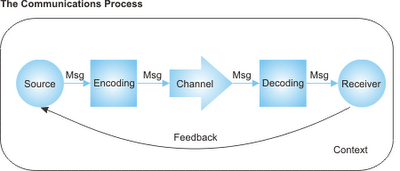
Answer: By process we mean that steps have to be taken and in a set/particular order to achieve a desired result/goal. These are the important elements of the communication process:

1. SENDER/ENCODER
The sender also known as the encoder decides on the message to be sent, the best/most effective way that it can be sent. All of this is done bearing the receiver in mind. In a word, it is his/her job to conceptualize.
The sender may want to ask him/herself questions like: What words will I use? Do I need signs or pictures?

2. MEDIUM
The medium is the immediate form which a message takes. For example, a message may be communicated in the form of a letter, in the form of an email or face to face in the form of a speech.

3. CHANNEL
The channel is that which is responsible for the delivery of the chosen message form. For example post office, internet, radio.

4. RECEIVER
The receiver or the decoder is responsible for extracting/decoding meaning from the message. The receiver is also responsible for providing feedback to the sender. In a word, it is his/her job to INTERPRET.

5. FEEDBACK
This is important as it determines whether or not the decoder grasped the intended meaning and whether communication was successful.

6. CONTEXT
Communication does not take place in a vacuum. The context of any communication act is the environment surrounding it. This includes, among other things, place, time, event, and attitudes of sender and receiver.

7. NOISE (also called interference)
This is any factor that inhibits the conveyance of a message. That is, anything that gets in the way of the message being accurately received, interpreted and responded to. Noise may be internal or external. A student worrying about an incomplete assignment may not be attentive in class (internal noise) or the sounds of heavy rain on a galvanized roof may inhibit the reading of a storybook to second graders (external noise).
The communication process is dynamic, continuous, irreversible, and contextual. It is not possible to participate in any element of the process without acknowledging the existence and functioning of the other elements.

Language as A Subset of Communication: The Case of Wild Children

In a previous post, Introduction to Communication Studies, the point was made that humans are not the only beings with a system of Communication and also that 'Language' is the name given to the human system of Communication. Therefore, though babies are born with the ability to communicate, they must be placed in an environment where they are able to acquire language inputs from older humans, otherwise they will not acquire Language. Below is a you tube clip on feral (wild) children, which emphasizes this point.


Linguistic Features of Jamaican Creole (Patois)

MODULE TWO (2) : LANGUAGE & COMMUNITY
Jamaican Creole is considered a language like any other for two basic reasons:
 1. It possesses the characteristic features of a language AND 2. It performs the functions of a language.      
Below is a brief outline of some of these linguistic features:
PHONOLOGY: the sound system of a language. Patois has a sound system independent of English.
  • Jamaican Creole does not use the 'th' sound but substitutes with two other sounds: the 't' sounds as in 'tik' for the English 'thick' and the 'd' sounds as in 'dem' for the English 'them'.
  • Jamaican Creole does not pronounce the 'h' sound at the beginning of English words. Therefore English 'hour' becomes 'our'. Similarly there is the tendency to hyper-correct and pronounce the 'h' sound at the beginning of words that do not require it, therefore English 'egg' becomes 'hegg' and 'exam' becomes 'hexam' and so on.
LEXICON: the vocabulary of a language. Although the lexical items of Patois are English based, many are used in non-English ways.
  • Some Patois words that appear to be similar to English words do not carry the same meaning, e.g. 'Ignorant' in Patois means easily angered, very upset and not lacking knowledge (which is the English definition). Another example is 'Belly' that in patois can refer to pregnancy.
  • Some English words are compounded to create nouns not present in English for example 'Foot bottom' for the sole of the feet and 'Eye water' for tears. 
  • Some Creole words are formed by reduplication (base words are repeated to form new words). For example friedi friedi to mean fearful or timid, chati chati to mean talks excessively or out of turn.
  • Some Creole words are adopted from other non-English languages, eg, maroon-Spanish, pikni-Portuguese, unu, (you plural) -Igbo
GRAMMAR: rules governing the correct use of language
  • Pluralization is signaled by the addition of the 'dem' after the noun eg. The people dem. Or to emphasize the numerical marker- 'de two book dem'.
  • Possession is not signaled, as in English, with the apostrophe 's' suffix but by the word 'fi' as in 'A fi mi handout'
  • Zero Copular construction. A Copular links the subject to the predicate. It is derived from the verb 'to be'. Creole can have a zero copular structure eg. Jane sick for Mary is sick in Englich or Jane de home for Jane is at home.
SYNTAX: the proper agreement of words in a sentence
  • Patois mainly uses syntax to highlight certain elements within a sentence while English often uses pronunciation by verbally stressing that which is to be emphasized. For example Creole: Is Susan eat di chicken? versus English Susan ate the chicken? Creole: Is di chicken Susan eat ? versus Susan ate the chicken?

Featured post

The Communication Process & The Elements of Communication

Systematic=Step by Step=Process Communication as a Process Human communication is interpersonal, it is purposive and it is a process....